
Circular fashion is often described as a materials problem.
We produce too much clothing. Garments are worn for too little time. Fabrics are difficult to separate. Recycling infrastructure remains limited. Valuable fibres, labour and energy are lost when clothing reaches landfill.
All of this is true.
But circular fashion is also an information problem. A garment cannot be repaired, resold, remade, redirected or recycled effectively when the people handling it do not know:
- What it is made from
- How it was constructed
- Which parts can be removed
- How it should be cared for
- Whether it has already been altered
- Who is capable of repairing it
- Where it can go next
- Whether environmental claims made about it can be verified
Australia has a clothing-volume problem
In 2024, Australians purchased approximately 1.51 billion items of clothing — around 55 items for every person. In the same year, approximately 220,000 tonnes of clothing textiles were sent to landfill in Australia.[1]
Australia currently has no nationally coordinated system for collecting and processing unwearable clothing. Existing reuse and recycling infrastructure is limited, while less than 5 per cent of textiles are recycled domestically.[1]
The challenge is therefore not simply persuading people to place unwanted clothing in a different bin. A functioning circular system needs to determine which garments are still wearable, which can be repaired, resold, altered or remade, which are suitable for fibre recovery, which contain materials that interfere with recycling, where the necessary services exist, and whether there is demand for the recovered material.
Each of those decisions depends on information. Without it, clothing is not moving through an intelligent circular system. It is merely moving between locations.
The garment becomes anonymous after purchase
Before a garment is sold, it may be connected to a product page, stock code, supplier, production order, technical specification and internal business records. After the sale, much of that connection disappears. The owner may retain only a brand label, a fibre-content label, a care label, an email receipt and a vague memory of where the garment was purchased.
Years later, the garment might be taken to an alterationist, donated to a charity, listed for resale, handed to a designer for remaking or placed into a textile-recovery collection. At each stage, someone may need to reconstruct its history from the object itself.
The garment remains physically present. Its information has been lost.
Circularity depends on a sequence of decisions
A circular garment does not follow one predetermined path. A shirt with a missing button needs a different intervention from one with a torn sleeve. A formal dress that no longer fits may need alteration rather than repair. A damaged wool coat may still contain high-value fabric. A heavily blended, bonded or embellished garment may be extremely difficult to recycle, even when its fibres appear recyclable on the label.
Someone needs enough information to make a judgement — material and trim composition, treatments, condition, construction method, previous repairs and alterations, remaining seam allowance, original and current measurements, care history, intended use, and the repair services, resale markets and recycling processes actually available.
Circularity is therefore not only about retaining materials. It is about retaining the knowledge needed to act on those materials.
Australia has identified a national data gap
In 2026, Seamless reported four major gaps in Australia's clothing system. Alongside limited collection infrastructure, underdeveloped markets for recycled textiles and regulatory uncertainty, it identified the absence of a consistent national data framework capable of tracking clothing flows from production through to end of life.[2]
That gap matters because Australia cannot confidently measure progress without consistent information about how much clothing enters the market, how long garments remain in use, how much is repaired or resold, what is donated or exported, what is collected for recycling, which materials are recovered — and how much ultimately reaches landfill.
Seamless has recommended compulsory data reporting as part of a nationally coordinated clothing-stewardship system.[2] This is not merely a reporting exercise: better system-level data can help identify where infrastructure is missing, which materials are entering the waste stream, which recovery pathways are viable and where investment could have the greatest effect.
Four types of information circular fashion needs
1 · Information about the garment
What is this object?
A fibre label is a useful start, but it may not tell the whole story. A garment labelled as primarily cotton may also contain polyester thread, fusible interfacing, elastic, plastic buttons, metal components and synthetic labels. Those details may be irrelevant while the garment is being worn. They become important when someone attempts to disassemble or recycle it. Australia's Circular Economy Framework identifies traceability as an important part of verifying the origin and performance of recycled materials and keeping products visible throughout their lifecycle.[5]
2 · Information about what has happened to it
What has this garment already experienced?
Over its life, a garment may be shortened, lengthened, taken in, let out, relined, dyed, patched, reinforced, embroidered, repaired, resold, remade, adapted for disability access, altered during or after pregnancy, or changed for a new wearer. These interventions can extend its useful life — but they also affect what happens next. A future alterationist may need to know the original seam allowance has already been used. A recycler may need to know a material was added during a repair. A reseller may need accurate updated measurements rather than the size printed on the label.
The history does not need to be exhaustive. It needs to be useful.
3 · Information about available people and services
Who can help this garment continue?
A tailor may be skilled in fit alterations but not invisible mending. An embroiderer may be able to disguise damage decoratively. A leather specialist may be needed for one component of an otherwise textile garment. A designer may see remaking potential that a general waste sorter cannot evaluate. Circular systems therefore need more than a directory — they need ways of connecting a particular garment problem with an appropriate capability.
4 · Information about outcomes
Did the circular intervention actually work?
A repair being booked does not necessarily mean a garment returned to regular use. A garment being collected does not necessarily mean it was recycled. A product containing recycled material does not necessarily mean it can be recycled again. Australia's clothing-system challenge is partly that these flows are difficult to see consistently at a national level.[2]
A circular claim is only as strong as the information behind it
Fashion language is full of broad environmental terms — circular, conscious, responsible, sustainable, recycled, recyclable, low impact, designed for longevity. These words can communicate meaningful work. They can also hide complexity.
A garment may contain recycled content but still be difficult to repair. It may be durable but made from a blend that cannot currently be recycled locally. It may be technically recyclable, with no accessible system to collect and process it. It may be marketed as circular even though the business has no way of knowing what happens after the original sale.
The Australian Competition and Consumer Commission states that environmental and sustainability claims must be true, accurate and supported by reasonable grounds — and warns that vague claims or the omission of important information can mislead consumers.[3]
Traceability should not become another decorative sustainability badge. It should help someone make a better decision.
Recycling is not the only pathway that needs data
Before fibres are recovered, a garment may be able to remain in use through better care, repair, alteration, resale, rental, sharing, adaptation, remaking, redesign or component recovery. Seamless identifies circular design, repair, reuse, rental, collection, sorting and recycling as interconnected priorities rather than isolated solutions.[4]
Each pathway needs different information. A reseller needs measurements, condition and clear imagery. A repairer needs to understand the damage and construction. An alterationist needs body and garment measurements. A rental operator needs condition, care and usage records. A remaker needs to know how much viable material remains. A recycler needs accurate composition and an available processing pathway.
There is no single piece of information that makes a garment circular. Circularity comes from making the right information available at the right stage.
Information is often trapped inside organisations
Clothing businesses already hold considerable information — in product-development software, technical packs, supplier spreadsheets, email, e-commerce platforms, order management, design files, production records, care labels and sustainability reports. The problem is not always that the information never existed. It may be inaccessible outside the original business, stored in incompatible systems, connected to a style rather than an individual garment, incomplete, lost when staff change, separated from the physical item, or deleted after the sale.
A circular system needs to consider how relevant information moves across organisational boundaries. That does not mean making every internal record public. It means deciding which information needs to survive the original transaction.
A garment is not finished when it is sold
Most fashion systems are organised around getting a product to its first customer, and treat the transaction as the end point. Circular fashion requires a different model. After delivery, the garment may continue to generate interactions: the wearer needs care guidance, a button needs replacing, the fit needs adjusting, the garment changes owners, a damaged area needs creative repair, the wearer's body changes, the garment is adapted for a different purpose — and eventually, the fabric is recovered.
Conventional e-commerce systems are excellent at managing products up to and around a sale. Circular systems also need to support what happens afterwards. The garment must be understood as an evolving object — not only a completed transaction.
Small makers hold information the system often overlooks
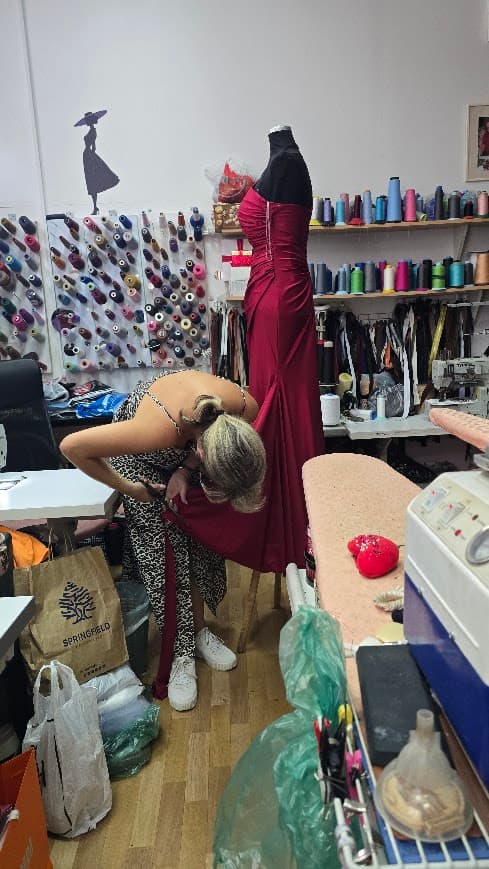
Tailors, alterationists, repairers, embroiderers, dyers, costume makers and other textile specialists regularly make decisions that extend garment life. They understand things that may never appear in a product database: whether a seam can safely be opened, whether a fabric will show needle marks, whether matching thread is available, whether embroidery can conceal damage, whether fabric can be harvested from another section, whether a garment should be remade rather than repaired.
This is not simply labour. It is knowledge.
Circular-fashion infrastructure should not treat makers as the final manual step after all important decisions have already been made. Their judgement is part of the information system.
Better data should not mean more unpaid administration
Calls for traceability can accidentally create more work for the smallest participants. A large fashion company may have compliance teams and dedicated sustainability staff. An independent tailor may be managing customer communication, quotes, measurements, materials, production, fittings, invoicing, photography, shipping — and their own skilled work. A circular system will fail if it depends on small makers completing extensive forms after every repair without being paid or receiving practical value in return.
Information should ideally be:
- Captured once where possible, and reused with permission
- Relevant to the task and easy to update
- Understandable across professions
- Proportionate to the garment and intervention
- Valuable to the person entering it
- Capable of supporting both small and large organisations
The objective is not to produce the largest possible dataset. It is to preserve the minimum useful information required for better decisions.
Not all garment information should be public
Made-to-measure and altered clothing may involve body measurements, fit preferences, disability-related requirements, pregnancy or postpartum adjustments, personal communication, home addresses and images of the wearer. This information does not need to follow a garment into resale or recycling. Circular infrastructure must distinguish between:
- Product information — materials, construction, care and recovery
- Service information — what is needed to complete a repair, alteration or other intervention
- Personal information — relating to the wearer; protected, and shared only when necessary and authorised
The garment may need a history. The wearer does not need to become part of that public history.
Digital tools cannot create circularity by themselves
A QR code does not make a garment circular. Neither does a database, digital product passport or sustainability dashboard. A digital record has limited value when the information is inaccurate, no one maintains it, repairers cannot access it, recyclers do not trust it, the physical garment cannot be identified, no collection pathway or viable next market exists, the design itself prevents disassembly, or the cost of action remains prohibitive.
Technology can support circularity. It cannot replace durable product design, repair skills, local capability, fairly paid labour, collection infrastructure, sorting, material processing, viable markets, consumer participation, regulation or industry cooperation. Australia's own circular-economy and clothing-stewardship work emphasises coordination across design, business models, recovery systems, industry and government.[5]
The information layer should connect these parts. It should not pretend to be the entire solution.
What useful circular-fashion infrastructure might enable
Without prescribing one particular platform or technology, a better information environment could make it easier to:
- Identify what a garment contains
- Find appropriate repair and alteration services
- Carry measurements accurately between approved interactions
- Preserve construction knowledge and record meaningful repairs
- Communicate condition honestly during resale
- Direct garments toward suitable collection pathways
- Separate reusable garments from unwearable textiles
- Verify recycled content and support credible environmental claims
- Credit the makers who contribute to a garment
- Understand where material value is being lost
- Measure which interventions genuinely extend clothing life
- Coordinate distributed participants without forcing them into one facility
Australia is already developing broader national guidance for tracing recycled content and improving transparency as materials move through supply chains.[6] The challenge for clothing is to ensure that information remains useful not only at industrial scale, but also during the ordinary human moments that keep garments in use.
Australia needs systems that connect the lifecycle
Seamless, Australia's clothing product-stewardship scheme, commenced operations in July 2024 with the aim of developing a coordinated national clothing system. Its priorities include circular design, longer-use business models, collection and recycling, and public education.[4] Australia's broader Circular Economy Framework sets a national ambition to double circularity by 2035.[5]
Achieving those ambitions will require physical systems — collection points, sorting facilities, repair capability, remanufacturing, recycling technology, transport and domestic markets for recovered materials. But physical infrastructure cannot operate intelligently without an information layer. A sorting facility needs to understand the incoming material. A repair network needs to understand demand and capability. A stewardship scheme needs to understand clothing flows. A customer needs to understand where to take a garment. A business needs evidence for its environmental claims. A maker needs a coherent brief. A recycler needs usable composition data.
We do not only need to know where clothing ends
We need to understand how garments move. Where was value preserved? Where was information lost? Which repair was successful? Which design prevented recovery? Which garments remained unworn? Which materials repeatedly appeared in landfill? Which makers had the skills to intervene? Which services were unavailable in particular places? Which supposed circular pathway simply moved waste somewhere less visible?
A circular system should learn from what happens to garments. Without that feedback, the industry continues designing new products without understanding why previous ones failed to remain in use.
Circular fashion is a coordination challenge
The transition will not be achieved by one brand, recycler, technology company, charity, government department or consumer group. Garments move between people and organisations with different incentives, language and systems. The owner thinks about fit and value. The tailor thinks about construction. The reseller thinks about condition and demand. The charity thinks about suitability and handling cost. The recycler thinks about composition and volume. The brand thinks about products, customers and compliance. Government needs aggregated evidence.
Circular infrastructure must create enough shared understanding for these participants to cooperate without requiring them to become the same kind of organisation. That is an information-design challenge as much as a waste-management challenge.
The material cannot circulate when the knowledge disappears
Australia needs to reduce clothing consumption, improve garment durability, expand repair and reuse, develop better collection systems and invest in domestic material recovery. But it also needs to preserve the information that makes those activities possible. A garment should not become an unidentified bundle of fibre the moment it leaves its original retailer.
The circular economy is often described as keeping products and materials in use for longer. To do that effectively, we also need to keep the right information in use.
Clothing works differently when it is created around a real person.
That idea raises broader questions. How should a garment's design, measurements, material choices and making knowledge move between the people involved? How can skilled makers participate in distributed clothing systems without important context being lost? How might digital infrastructure support customisation, repair, remaking and longer garment use without replacing human judgement?
We are interested in the information layer connecting garments, people and skilled makers — and in how that layer might support more personal and circular ways of making clothing in Australia. The answers will not come from technology alone. But better information can help people, materials and skills find one another before a garment becomes waste.
For designers, the practical version of that idea is on-demand production — see how to start a fashion label without holding inventory.
Sources
- [1]Australia's clothing waste challenge — Seamless
- [2]Evidence for change: Australia's circular clothing future — Seamless
- [3]A guide to making environmental claims for business — ACCC
- [4]FAQs — Seamless Australia
- [5]Australia's Circular Economy Framework — DCCEEW
- [6]A national framework for recycled content traceability — DCCEEW